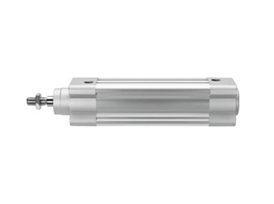
Introduction to FESTO (Festo) Dual Airbag Cylinder EB - 215 - 155
FESTO (Festo), as a globally renowned supplier of automation technology, is known for its products' high quality, high performance, and innovation. The Dual Airbag Cylinder EB - 215 - 155 is one of Festo's products with a unique design and outstanding performance. This cylinder features a dual airbag structure design, which, compared to traditional cylinders, can provide more stable and powerful driving force.
In terms of specifications, the numbers in 'EB - 215 - 155' have specific meanings. '215' may represent certain key dimensions or performance indicators of the cylinder, while '155' corresponds to related parameters. Its dimensions are carefully designed to meet installation requirements in various industrial scenarios and to maximize efficiency within limited space. The housing is made of high-strength materials, offering good wear resistance and corrosion resistance, capable of adapting to various harsh working environments, ensuring the long-term stable operation of the cylinder.
Operating Principle and Advantages of FESTO (Festo) Dual Airbag Cylinder EB - 215 - 155
The operating principle of the Festo Dual Airbag Cylinder EB - 215 - 155 is based on pneumatic drive. When compressed air enters the cylinder, it acts on both airbags simultaneously. The design of the dual airbags enables the cylinder to produce a more uniform force during operation, avoiding the uneven force issues that may occur with traditional single airbag cylinders. This uniform force distribution not only improves the efficiency of the cylinder's operation but also extends its service life.
In terms of advantages, firstly, it has excellent dynamic performance. The dual airbag structure can produce greater thrust under the same air pressure conditions, thereby driving heavier loads. Secondly, the cylinder has a very fast response speed. Due to the synergistic work of the dual airbags, the air pressure can be quickly converted into mechanical motion, making the equipment's operation more efficient. Furthermore, it has extremely high operational stability. The design of the dual airbags makes the cylinder's movement smoother during operation, reducing vibration and noise, providing operators with a relatively quiet and comfortable working environment. In addition, the Festo Dual Airbag Cylinder EB - 215 - 155 also has good energy-saving characteristics. Through optimized internal structural design, it can effectively reduce the consumption of compressed air, thereby reducing operating costs.
Application Scenarios and Maintenance Essentials of FESTO (Festo) Dual Airbag Cylinder EB - 215 - 155
The Festo Dual Airbag Cylinder EB - 215 - 155 is widely used in various industrial fields. On automated production lines, it can be used for material handling, positioning, and assembly tasks. Due to its powerful driving force and stable performance, it can ensure the efficient operation of the production line, improving production efficiency and product quality. In the packaging industry, the cylinder can be used for actions such as opening and closing, clamping of packaging machinery, ensuring the accuracy and speed of packaging.
Double Diaphragm Cylinder EB-215-155 belongs to the Drives series under FESTO company, model number EB-215-155. To purchase or inquire about Double Diaphragm Cylinder EB-215-155, you can directly contact 158 0047 0089 (Mr. He).