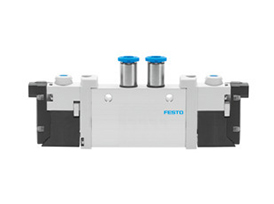
FESTO (Festo) Vacuum Safety Valve ISV - M5 Overview
FESTO (Festo), as a globally renowned supplier of automation technology, is known for its products of high quality, high performance, and innovative design. The Festo vacuum safety valve ISV - M5 is one of its important products with significant application value. This safety valve is mainly used in vacuum systems, ensuring the safe and stable operation of the system under specific conditions.
The design of ISV - M5 is compact and small, which means it will not take up too much space during installation, making it particularly suitable for equipment and systems with high space requirements. Its housing is made of robust and durable materials, with good shock resistance and corrosion resistance, capable of adapting to various complex industrial environments. Whether in a humid, dusty workshop or on a production line with some chemical corrosion, ISV - M5 can work reliably.
From an aesthetic perspective, ISV - M5 has a clear and simple structure, with a reasonable layout of interfaces and components, making it convenient for users to connect and operate. Its overall design conforms to ergonomic principles, allowing operators to feel comfortable and convenient even with frequent operations.
FESTO (Festo) Vacuum Safety Valve ISV - M5 Working Principle and Functional Features
The working principle of ISV - M5 is based on precise pressure control mechanisms. During normal vacuum system operation, it allows gas to flow along a predetermined path, ensuring that the system's vacuum level is maintained within an appropriate range. When there is an abnormal change in the system's pressure, such as a sudden increase in pressure exceeding the set safety value, ISV - M5 will respond quickly.
The safety valve senses pressure changes through an internal pressure sensing device. Once the trigger threshold is reached, the valve will immediately close, preventing further gas flow, thereby protecting the system from damage due to excessively high pressure. This rapid response mechanism can effectively protect various equipment in the vacuum system, such as vacuum pumps, vacuum containers, etc., extending their service life and reducing maintenance costs.
ISV - M5 also has good sealing properties. In the closed state, it can effectively prevent gas leakage, ensuring that the system's vacuum level is not affected. The sealing material has been carefully selected and treated, possessing excellent sealing performance and aging resistance, capable of maintaining good sealing effects over the long term.
In addition, the adjustment performance of this safety valve is also very good. Users can precisely adjust the opening pressure of the safety valve according to actual usage needs through simple operations. This allows ISV - M5 to adapt to different vacuum systems and working conditions, giving it a broader applicability.
FESTO (Festo) Vacuum Safety Valve ISV - M5 Application Areas and Market Advantages
The Festo vacuum safety valve ISV - M5 is widely applied in many fields. In the electronics manufacturing industry, vacuum systems are commonly used for chip manufacturing, circuit board encapsulation, and other work
Vacuum safety valve ISV-M5 belongs to the Valves and Islands series under FESTO company, model number ISV-M5. To purchase or inquire about Vacuum safety valve ISV-M5, you can directly contact 158 0047 0089 (Mr. He).