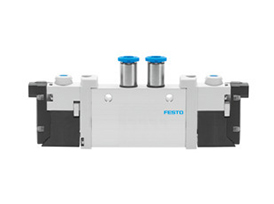
FESTO (Festo) Delay Valve VZ - 3 - PK - 3 Introduction
FESTO (Festo), as a globally renowned supplier of automation technology, is known for its products' high quality, high performance, and innovative design. The Delay Valve VZ - 3 - PK - 3 is one of many outstanding products from Festo, playing a significant role in the field of industrial automation.
This delay valve is mainly used to control the time delay function in pneumatic systems. In scenarios where precise control of action time is required, it can accurately achieve the on-off of air paths according to preset times, ensuring the entire system runs in a predetermined rhythm. For example, in automated production lines, certain processes require a specific time interval before proceeding to the next operation, and the Delay Valve VZ - 3 - PK - 3 can well meet this need.
Visually, the VZ - 3 - PK - 3 is designed compactly with a small volume, which means it does not require much space during installation and is well-suited for devices with limited space. Moreover, its housing is made of robust and durable materials, capable of withstanding various complex industrial environments, featuring good shock and vibration resistance, ensuring the stability and reliability of the product during long-term use.
FESTO (Festo) Delay Valve VZ - 3 - PK - 3's Working Principle and Features
The working principle of the Festo Delay Valve VZ - 3 - PK - 3 is based on pneumatic control and time delay mechanisms. When a control signal is input, the pneumatic components inside the valve start to work, adjusting the internal air paths and throttle devices to control the flow of gas, thus achieving a delay effect.
It has several notable features. First, the delay time is adjustable over a wide range. Users can easily set different delay times according to actual needs by adjusting the knob on the valve, ranging from a few milliseconds to several seconds, providing the flexibility to adapt to various application scenarios. Second, it has a fast response. After receiving a control signal, the delay valve can quickly react, rapidly opening or closing the air paths, reducing the system's response time and improving the efficiency of the entire system.
Additionally, the delay valve has good sealing properties. Advanced sealing technology and materials are used to effectively prevent gas leakage, ensuring the normal operation of the system and reducing energy waste. Moreover, its operation is simple and convenient, allowing even those without a professional technical background to quickly master the operating methods for installation and adjustment.
FESTO (Festo) Delay Valve VZ - 3 - PK - 3's Application Areas and Market Prospects
The Festo Delay Valve VZ - 3 - PK - 3 is widely applied in various industrial fields. In the automotive manufacturing industry, it can be used to control various pneumatic equipment on the car assembly line, such as the clamping and releasing times of fixtures, ensuring the precise installation of components.
Delay valve VZ-3-PK-3 belongs to the Valves and Islands series under FESTO company, model number VZ-3-PK-3. To purchase or inquire about Delay valve VZ-3-PK-3, you can directly contact 158 0047 0089 (Mr. He).