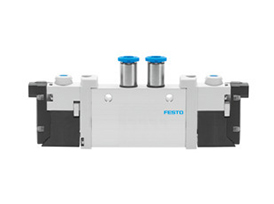
Basic Information of FESTO (Festo) Solenoid Valve MHE2 - MS1H - 3/2G - QS - 4 - K
FESTO (Festo), as a globally renowned supplier of automation technology, has a wide range of applications for its solenoid valve MHE2 - MS1H - 3/2G - QS - 4 - K in the field of industrial automation. This solenoid valve belongs to the MHE2 series, which is known for its high performance and reliability.
In terms of the model, 'MHE2' represents the series it belongs to, 'MS1H' may be the specific model identifier within this series, '3/2G' indicates that this is a three-way two-position solenoid valve, which has three different working positions and can switch between two different working states, suitable for various complex pneumatic control circuits. 'QS - 4' shows that the solenoid valve is equipped with QS - 4 specification quick connectors, which are easy to install, can quickly connect air pipes, improve installation efficiency, and have good sealing performance, reducing the risk of air leakage. 'K' may be an identifier for some special functions or configurations of the product.
In terms of design, the FESTO (Festo) solenoid valve MHE2 - MS1H - 3/2G - QS - 4 - K adopts a compact structural design, with a small volume that does not take up too much installation space, which is very important for industrial equipment with high space requirements. At the same time, its housing is made of high-quality materials, with good corrosion resistance and wear resistance, capable of adapting to various harsh industrial environments.
Operating Principle and Performance Characteristics of FESTO (Festo) Solenoid Valve MHE2 - MS1H - 3/2G - QS - 4 - K
The operating principle of this solenoid valve is based on the movement of the valve core controlled by electromagnetic force. When the solenoid valve is powered on, the electromagnetic coil generates electromagnetic force, attracting the valve core to move, thereby changing the on-off state of the air path, achieving control of the pneumatic system. When the power is off, the valve core returns to its initial position under the action of the spring, restoring the original air path state.
In terms of performance, the FESTO (Festo) solenoid valve MHE2 - MS1H - 3/2G - QS - 4 - K features a fast response speed. Its quick response time ensures that the pneumatic system executes control commands accurately and in a timely manner, improving the efficiency of the system's operation. For example, on some automated production lines that require rapid switching of air paths, this solenoid valve can respond quickly to ensure the continuity and stability of production.
Furthermore, the flow characteristics of this solenoid valve are good. It can provide a large flow rate to meet the air requirements of different pneumatic equipment. At the same time, its pressure range is relatively wide, allowing it to work stably under certain pressure fluctuations, adapting to different industrial application scenarios. Moreover, its sealing performance is excellent, effectively preventing gas leakage, reducing energy consumption, and improving the economic efficiency of the system.
In terms of reliability, Festo has subjected this solenoid valve to strict
Solenoid valve MHE2-MS1H-3/2G-QS-4-K belongs to the Valves and Islands series under FESTO company, model number MHE2-MS1H-3/2G-QS-4-K. To purchase or inquire about Solenoid valve MHE2-MS1H-3/2G-QS-4-K, you can directly contact 158 0047 0089 (Mr. He).