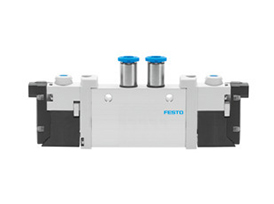
FESTO (Festo) Dual Electric Control Solenoid Valve JMFH - 5 - 1/4 - S - B Overview
FESTO, as a globally renowned supplier of automation technology, is known for its products' high quality, performance, and reliability. The dual electric control solenoid valve JMFH - 5 - 1/4 - S - B is a representative product of FESTO. This solenoid valve is widely used in the field of industrial automation, capable of precisely controlling the flow direction and rate of gases or liquids, providing a strong guarantee for the stable operation of various automation systems.
Looking at the model, 'JMFH' represents the series name of the solenoid valve, '5' typically indicates the number of working positions of the solenoid valve, meaning it can achieve various different working state transitions; '1/4' indicates the interface size is 1/4 inch, a specification commonly used in industrial applications, facilitating connections with various pipes and equipment; 'S' may represent certain special functions or characteristics of the solenoid valve; 'B' could be the product version or other related identifiers.
Features of FESTO (Festo) Dual Electric Control Solenoid Valve JMFH - 5 - 1/4 - S - B
Firstly, in terms of performance, this solenoid valve features a rapid response. It can complete the opening and closing actions of the valve in a short time, with an extremely short response time, which is crucial for automation systems that require rapid fluid direction changes. For example, on some high-speed production lines, rapid response ensures efficient production, reduces production cycles, and improves production efficiency.
Secondly, the valve has good sealing properties. Advanced sealing technology and materials are used, effectively preventing media leakage, ensuring the stability and safety of the system. Even in harsh working environments such as high pressure and high temperature, it can maintain good sealing performance, reducing energy waste and environmental pollution.
Furthermore, it has high reliability and durability. FESTO strictly controls quality in the production process, selecting high-quality materials and advanced manufacturing processes, allowing the solenoid valve to withstand long-term frequent use and various complex working conditions. The internal electromagnetic coil has good insulation properties and anti-interference capabilities, ensuring stable operation of the solenoid valve, reducing the failure rate, and lowering maintenance costs.
In addition, the solenoid valve has good compatibility. It can be seamlessly integrated with other FESTO automation products, such as cylinders, sensors, etc., to form a complete automation solution. It can also be used in conjunction with equipment from other brands, showing strong versatility.
Application Scenarios of FESTO (Festo) Dual Electric Control Solenoid Valve JMFH - 5 - 1/4 - S - B
In the field of mechanical manufacturing, this solenoid valve is widely used in various automated production lines. For example, on automotive manufacturing production lines, it can be used to control the clamping and releasing of pneumatic clamps, achieving precise positioning and processing of components.
Double Solenoid Valve JMFH-5-1/4-S-B belongs to the Valves and Islands series under FESTO company, model number JMFH-5-1/4-S-B. To purchase or inquire about Double Solenoid Valve JMFH-5-1/4-S-B, you can directly contact 158 0047 0089 (Mr. He).