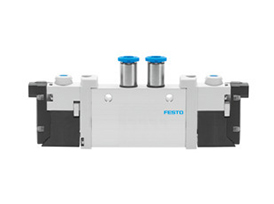
FESTO (Festo) One-way Throttle Valve GR - QS - 3 Introduction
FESTO (Festo), as a globally renowned supplier of automation technology, is known for the high quality, reliability, and innovation of its products. The one-way throttle valve GR - QS - 3 is an important product with significant application value in the Festo product line.
This one-way throttle valve is mainly used to control the flow and direction of gas in pneumatic systems. Its core function is to throttle in one direction, limiting the flow of gas, while allowing gas to flow freely in the opposite direction. The 'GR' in the model represents the series of the throttle valve, while 'QS - 3' specifies the interface size and related parameters. 'QS' indicates the type of quick connector, and '3' represents the interface size as a specific specification, allowing it to match and connect well with corresponding size pneumatic pipes and equipment.
From an aesthetic design perspective, the FESTO one-way throttle valve GR - QS - 3 is characterized by its compact and refined features. Its small size makes it easy to install and layout in various space-constrained pneumatic systems, and it also facilitates integration with other pneumatic components. The housing is made of high-quality materials, offering good corrosion resistance and wear resistance, capable of adapting to different working environments and ensuring the long-term stable operation of the product.
Working Principle and Features of FESTO (Festo) One-way Throttle Valve GR - QS - 3
The working principle of this one-way throttle valve is based on its unique internal structural design. When gas enters from the direction that allows free flow, the valve's one-way valve opens, allowing gas to pass through smoothly with almost no resistance. When gas enters from the throttling direction, the throttle valve takes effect, controlling the gas flow by adjusting the size of the throttle opening. Users can precisely adjust the throttle opening according to actual work requirements by rotating the adjustment knob on the throttle valve, thus achieving fine control over the gas flow.
The FESTO one-way throttle valve GR - QS - 3 has several notable features. First, its throttling accuracy is very high. Thanks to Festo's advanced manufacturing processes and precise machining technology, the throttle valve can achieve high accuracy when adjusting the flow, meeting the strict flow control requirements of various pneumatic systems. Second, it has a fast response speed. When the direction of gas flow changes or the flow needs to be adjusted, the throttle valve can quickly respond, promptly adjusting the flow and direction of gas, ensuring the efficient operation of the pneumatic system.
Additionally, the throttle valve has good sealing properties. Its internal sealing structure is designed rationally and uses high-performance sealing materials, effectively preventing gas leakage, improving the efficiency and safety of the system. At the same time, its operation is very simple. Users can easily adjust the gas flow by simply rotating the adjustment knob, without the need for complex operation steps or professional technical knowledge.
FESTO (Festo) One-way Throttle Valve GR
One-Way Throttle Valve GR-QS-3 belongs to the Valves and Islands series under FESTO company, model number GR-QS-3. To purchase or inquire about One-Way Throttle Valve GR-QS-3, you can directly contact 158 0047 0089 (Mr. He).