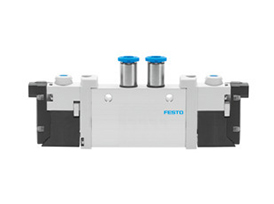
FESTO (Festo) Foot Valve F - 5 - 1/4 - B Overview
FESTO, as a globally renowned supplier of automation technology, is known for the high quality, reliability, and innovation of its products. The Foot Valve F - 5 - 1/4 - B is a representative product of Festo. This foot valve is mainly used in the field of industrial automation, controlling the air path through foot operation, providing operators with a convenient and efficient operating experience.
In the model number F - 5 - 1/4 - B, the letter 'F' typically represents the type of foot valve, '5' may indicate some specific functions or series number of the foot valve, '1/4' represents its interface size of 1/4 inch, which is a common specification for air path interfaces, facilitating connection with other pneumatic components. 'B' may represent certain specific configurations or versions of the product.
From an ergonomic perspective, the FESTO Foot Valve F - 5 - 1/4 - B has been designed with the operator's comfort in mind. The shape and size of the pedal have been carefully crafted to ensure comfort during prolonged use, reducing fatigue. At the same time, its housing is made of durable materials capable of withstanding external impacts and harsh working conditions, ensuring the reliability and service life of the product.
FESTO (Festo) Foot Valve F - 5 - 1/4 - B Working Principle and Performance Features
The working principle of the Festo Foot Valve F - 5 - 1/4 - B is based on pneumatic control technology. When the operator presses the pedal, the valve core inside the foot valve shifts, changing the state of the air path. Specifically, it can achieve functions such as conducting, cutting off, or diverting compressed air. When the pedal is released, the valve core returns to its initial position under the action of a spring, and the air path state also changes.
This foot valve has many outstanding performance features. First, its response speed is very fast. The valve core can move quickly in response to the instant when the operator presses down or releases the pedal, which is crucial for some automation production processes with high time requirements. Second, it has good sealing properties. High-quality sealing materials and advanced sealing structures are used to effectively prevent the leakage of compressed air, ensuring the stability and reliability of the air path system.
Additionally, the F - 5 - 1/4 - B foot valve has a high flow capacity. It can accommodate a large flow of compressed air, providing sufficient power for pneumatic actuators. At the same time, the operating force of the foot valve is moderate, neither too light to cause accidental operation nor too heavy to make the operator feel strenuous, ensuring the accuracy and comfort of operation.
FESTO (Festo) Foot Valve F - 5 - 1/4 - B Application Scenarios and Maintenance Essentials
The FESTO Foot Valve F - 5 - 1/4 - B is widely used in many industrial fields
Foot Valve F-5-1/4-B belongs to the Valves and Islands series under FESTO company, model number F-5-1/4-B. To purchase or inquire about Foot Valve F-5-1/4-B, you can directly contact 158 0047 0089 (Mr. He).