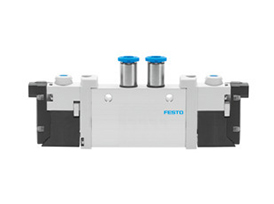
FESTO (Festo) One-way Throttle Valve GR - QS - 8 Basic Introduction
FESTO, as a globally renowned supplier of automation technology, is known for the high quality and reliability of its products. The one-way throttle valve GR - QS - 8 is a highly regarded product in the Festo lineup. The model number 'GR' represents the series it belongs to, 'QS' typically indicates that its connection method is a quick connector, and '8' signifies that its interface size is 8mm.
From an aesthetic perspective, the GR - QS - 8 is designed compactly and is small in size, which means it does not take up much space during installation, making it particularly suitable for industrial automation systems with limited space. Its housing is made of high-strength engineering plastic or metal material, offering good corrosion resistance and mechanical strength, allowing it to operate stably in harsh industrial environments.
In terms of working principle, the one-way throttle valve GR - QS - 8 allows air to flow freely in one direction, while in the opposite direction, the flow rate can be controlled by adjusting the throttle valve. When air flows through in the direction that allows free flow, the one-way valve inside the valve opens, allowing the air to pass smoothly; when the air flows in the opposite direction, the one-way valve closes, and at this point, the throttle port size can be changed by rotating the throttle knob, thus achieving precise control over the air flow rate.
FESTO (Festo) One-way Throttle Valve GR - QS - 8 Application Scenarios
In the field of industrial automation, the FESTO one-way throttle valve GR - QS - 8 has a wide range of applications. Firstly, in pneumatic control systems, it is commonly used to regulate the speed of pneumatic cylinders. By installing it at the intake or exhaust port of a pneumatic cylinder, GR - QS - 8 can precisely control the air flow entering or exiting the cylinder, thereby adjusting the speed of the piston movement. For example, in handling equipment on an automated production line, the speed of the pneumatic cylinder needs to be adjusted according to different work tasks, and at this point, GR - QS - 8 can be used to achieve this function, ensuring the efficient operation of the equipment.
Secondly, GR - QS - 8 also plays a significant role in the use of pneumatic tools. Pneumatic tools such as pneumatic wrenches and pneumatic screwdrivers, their efficiency and service life are closely related to the stability of air pressure and airflow. By installing the one-way throttle valve GR - QS - 8, the air flow into the pneumatic tools can be regulated, ensuring stable operation under different working conditions, improving work quality and the service life of the tools.
Additionally, in some experimental equipment and test platforms, GR - QS - 8 is also used. These devices typically require precise control over the flow rate and pressure of air to ensure the accuracy of experiments and test results. The one-way throttle valve GR - QS - 8 can meet this need for precise control, providing reliable support for experimental and testing work.
FESTO (Festo) One-way Throttle Valve GR -
One-Way Throttle Valve GR-QS-8 belongs to the Valves and Islands series under FESTO company, model number GR-QS-8. To purchase or inquire about One-Way Throttle Valve GR-QS-8, you can directly contact 158 0047 0089 (Mr. He).