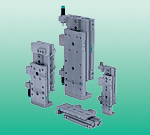
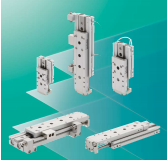
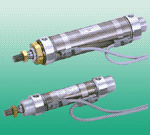
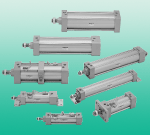
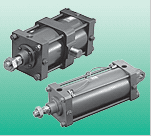
Rodless cylinder, SRL3-00-63B-870; rodless cylinder, sealed all-metal steel belt slider MEDAN rodless cylinder uses a full metal sealed steel belt slider on the slider, such a design makes the rodless cylinder operation smoother and the service life longer. Introduction to how the basic valve controls the hydraulic cylinder; when the basic valve is powered on, the direct-acting two-position four (five) way solenoid valve directly lifts the iron core valve rod to close the B working port, and the pressure source gas or liquid flows to the A working port, pushing the piston of the pneumatic (hydraulic) cylinder to the D end. This solenoid valve can be used universally. The pilot-operated two-position four (five) way basic valve relies on the inlet pressure of the pilot hole to push the valve rod inside the valve for the direction change function of gas (liquid). The pilot-operated two-position four or five-way basic valve cannot be used universally in gas and liquid media due to different structures and sealing forms. When the basic valve is powered off, the closing piece will return to its original position, and the solenoid valve will close. In this action process, because it is the direct up and down movement of the closed piece iron core that can achieve the on-off work of the solenoid valve medium, it is also called a basic valve. (Note: normally closed solenoid valve opens when powered on, normally open solenoid valve closes when powered off is a normally closed solenoid valve, normally open solenoid valve closes when powered on, normally closed solenoid valve opens when powered off is a normally open solenoid valve) The nominal size of the basic valve is not greater than DiVIO, and the small caliber direct-acting solenoid valve coil is powered on, the magnetic circuit generates electromagnetic force, lifts the moving iron core, overcomes the reset spring force to open the valve seat, and the working medium immediately flows through the pipeline. When the coil is powered off, the electromagnetic force disappears, the moving iron core falls due to its own weight and spring force, seals the valve seat, and cuts off the working medium flow in the pipeline. Before installing the solenoid valve, the pipeline should be cleaned to remove dirt and welding slag. After installation, to ensure that no impurities remain in the valve body, the valve should be cleaned again, that is, when the medium is turned on, all valves should be opened to prevent impurities from getting stuck. After using the handwheel mechanism, it should be restored to the original neutral position. Automatic control valves need to be equipped with some auxiliary valves and fittings on the pipeline when working. For example, the isolation bypass shown in Figure 1 is a typical installation method, which requires配 three manual valves, where manual valve 1 is the bypass valve, manual standby. Manual valves 2 and 3 are isolation valves, ensuring the online maintenance of automatic control valve 5. Of course, two three-way 4 and a coupling 6 are also needed. This pipeline system takes up a lot of space, is time-consuming to install, and is prone to leakage. The ZDF series multi-function solenoid valve cleverly eliminates these additional accessories while still having the function of isolation bypass, and thus won the Geneva International New Technology Gold Award. Automatic control valves need to install filters in front. The joint use of multiple automatic control valves often requires the installation of check valves to prevent interference between pipelines. Single-way solenoid valves, combined solenoid valves, and solenoid valves with filters have already played a role in simplifying the pipeline. (Our company has also launched a back-flushing filter valve, which has both switching and filtering functions, and does not require valve disassembly to flush the filter element, and has obtained Chinese and American invention patents.) Rodless cylinder, SRL3-00-63B-870 before the linkage test, the process pipeline must undergo strict purging and pass, purging unqualified pipelines are strictly prohibited from installation, because the residual substances in the pipeline such as welding slag, dust, etc. will damage the valve core and valve seat sealing surface. SRL3-00-63B-870 MEDAN is the main product.
Rodless cylinder SRL3-00-63B-870 belongs to the Air Pressure Cylinders series under CKD company, model number SRL3-00-63B-870. To purchase or inquire about Rodless cylinder SRL3-00-63B-870, you can directly contact 158 0047 0089 (Mr. He).