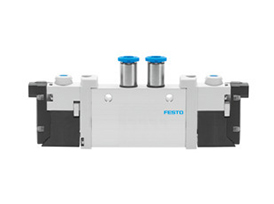
FESTO (Festo) Solenoid Valve CPE10 - M1BH - 5J - M7 Basic Information
FESTO, as a globally renowned supplier of automation technology, has a wide range of applications for its solenoid valves in the industrial sector. The CPE10 - M1BH - 5J - M7 is a highly regarded solenoid valve product from the Festo line. In terms of the model, CPE10 represents the series of the solenoid valve, which typically features a compact design and high efficiency. M1BH indicates its specific interface specifications and functional characteristics, allowing it to adapt well to a variety of different systems. 5J represents certain specific configurations of the solenoid valve, which may involve its operating mode, number of air passages, etc. M7 indicates its electrical connection method, adopting the M7 electrical interface for easy connection with other electrical equipment.
This solenoid valve features a compact design with minimal space requirements, which is very important for industrial equipment with high space demands. It utilizes advanced manufacturing processes, with a robust and durable housing capable of withstanding various harsh industrial environments. In terms of protection level, it has good dust and water resistance, allowing it to operate stably in humid and dusty environments, reducing the probability of faults caused by environmental factors.
FESTO (Festo) Solenoid Valve CPE10 - M1BH - 5J - M7 Working Principle and Performance Characteristics
The working principle of the Festo solenoid valve CPE10 - M1BH - 5J - M7 is based on electromagnetic induction. When the solenoid valve's coil is energized, it generates a magnetic field that drives the valve core to move, thereby changing the state of the air passage. When the coil is de-energized, the valve core returns to its initial position under the action of a spring, and the air passage state also changes. This mode of operation allows the solenoid valve to control the flow of gas quickly and accurately, achieving precise control of industrial equipment.
In terms of performance, the solenoid valve has the characteristic of a fast response. It can complete the movement of the valve core in a short time, achieving the switching of the air passage, which is crucial for some industrial production processes that require high control precision and response speed. For example, in automated production lines, rapid air passage switching can improve production efficiency and reduce production cycles. In addition, its flow characteristics are also excellent, capable of providing a large gas flow to meet the air requirements of different industrial equipment. At the same time, the solenoid valve has low power consumption and adopts energy-saving design, which can save a lot of energy costs for the enterprise in the long-term use.
The Festo solenoid valve CPE10 - M1BH - 5J - M7 also has good reliability and stability. It has undergone strict quality inspection and performance testing, capable of maintaining stable performance during long-term continuous operation. The valve core and seals inside are made of high-quality materials, featuring wear and corrosion resistance, effectively extending the service life of the solenoid valve and reducing maintenance costs for the equipment.
Solenoid Valve CPE10-M1BH-5J-M7 belongs to the Valves and Islands series under FESTO company, model number CPE10-M1BH-5J-M7. To purchase or inquire about Solenoid Valve CPE10-M1BH-5J-M7, you can directly contact 158 0047 0089 (Mr. He).