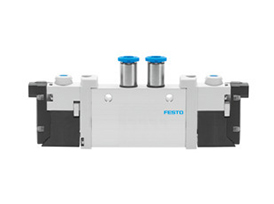
FESTO (Festo) Throttle Valve GRO-QS-3 Introduction
FESTO (Festo), as a globally renowned supplier of automation technology, is known for the high quality, reliability, and innovation of its products. The FESTO throttle valve GRO-QS-3 is one of the company's highly regarded products. This throttle valve is widely used in the field of industrial automation, capable of precisely controlling the flow of fluids, thereby meeting the needs of various operating conditions.
The FESTO throttle valve GRO-QS-3 employs advanced design concepts and manufacturing processes. Its compact design takes up little space, making it easy to install and layout in various equipment. The material used is of high quality, offering good corrosion resistance and wear resistance, allowing stable operation in harsh working environments and significantly extending the product's service life.
In terms of connection, GRO-QS-3 uses QS quick connectors, which are characterized by easy installation and good sealing. Users can quickly connect the throttle valve to other components without the need for complex tools and operations, improving installation efficiency and reducing the risk of leakage due to improper connections.
FESTO (Festo) Throttle Valve GRO-QS-3 Working Principle and Performance Features
From a working principle perspective, the FESTO throttle valve GRO-QS-3 mainly controls the flow of fluids by changing the throttle cross-section or throttle length. When the fluid passes through the throttle valve, the valve core adjusts according to actual needs, changing the flow area of the fluid and achieving precise control over the flow rate. This mode of operation allows the throttle valve to maintain stable performance under different pressures and flow conditions.
The throttle valve has excellent flow regulation performance. It can achieve continuous and precise flow regulation over a wide range, meeting the flow requirements of different operating conditions. Whether in fine control situations with small flows or in industrial production with large flows, GRO-QS-3 performs well.
Additionally, the FESTO throttle valve GRO-QS-3 also has good pressure stability. During fluid flow, it effectively reduces pressure fluctuations, ensuring the stable operation of the system. This is particularly important for equipment and processes that have high requirements for pressure stability, as it can prevent equipment damage and production quality issues caused by pressure fluctuations.
In terms of response speed, GRO-QS-3 also performs well. It can quickly respond to flow regulation commands, promptly adjusting the position of the valve core, thereby achieving rapid control over the flow rate. This quick response characteristic gives the throttle valve a clear advantage in applications that require high real-time performance.
FESTO (Festo) Throttle Valve GRO-QS-3 Application Areas and Maintenance
The FESTO throttle valve GRO-QS-3 is widely used in many fields. In pneumatic control systems, it can be used for
Throttle Valve GRO-QS-3 belongs to the Valves and Islands series under FESTO company, model number GRO-QS-3. To purchase or inquire about Throttle Valve GRO-QS-3, you can directly contact 158 0047 0089 (Mr. He).