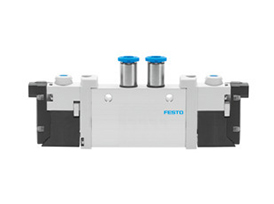
FESTO (Festo) Rotary Lever Valve RW - 3 - M5 Overview
FESTO, as a globally renowned supplier of automation technology, is known for its products' high quality, innovative design, and superior performance. The rotary lever valve RW - 3 - M5 is one of many outstanding products from FESTO. This valve is widely used in the field of industrial automation and can meet various complex work requirements.
From the perspective of design, the RW - 3 - M5 features a compact and robust structure. Its small size allows for easy installation in equipment with limited space, without taking up too much space resource. At the same time, the sturdy housing material ensures stable operation even in harsh working environments, with good shock and vibration resistance.
In terms of connection, it uses an M5 interface, which has a high degree of universality and is convenient for connecting to various different pipes and equipment. Users can install it quickly without complex adaptation operations, improving work efficiency.
FESTO (Festo) Rotary Lever Valve RW - 3 - M5 Working Principle and Performance Features
The working principle of the RW - 3 - M5 is based on the movement of the rotary lever to achieve the opening and closing of the valve. When an external control signal acts on the rotary lever, the lever rotates around a fixed axis, thereby driving the movement of the valve core inside. When the valve core moves to different positions, it can achieve different working states of the valve, such as opening, closing, or adjusting the flow rate.
In terms of performance, this valve has an extremely high response speed. It can react to control signals in a short time, achieving rapid opening and closing actions. This is very important for some automation production processes with high time requirements, effectively improving production efficiency.
Additionally, the RW - 3 - M5 also has excellent sealing performance. The design of its internal sealing structure is reasonable, effectively preventing media leakage. Whether in high-pressure or low-pressure working environments, it can ensure good sealing effects, ensuring the stable operation of the system. At the same time, the valve's flow regulation accuracy is also high, allowing precise control of the media flow size according to actual needs, meeting the requirements of different production processes.
In terms of reliability, FESTO's quality assurance gives the RW - 3 - M5 a long service life. It has undergone strict quality inspection and reliability testing, maintaining stable performance over long periods of continuous operation, reducing equipment maintenance costs and downtime.
FESTO (Festo) Rotary Lever Valve RW - 3 - M5 Application Scenarios and Market Prospects
Due to its outstanding performance and features, the RW - 3 - M5 is widely used in multiple industries. In the automotive manufacturing industry, it can be used in the pneumatic control system of the automotive production line to achieve precise control of various pneumatic actuators, such as cylinders
Rotary lever valve RW-3-M5 belongs to the Valves and Islands series under FESTO company, model number RW-3-M5. To purchase or inquire about Rotary lever valve RW-3-M5, you can directly contact 158 0047 0089 (Mr. He).