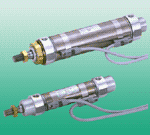
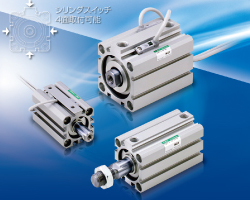
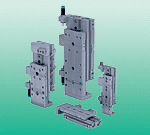
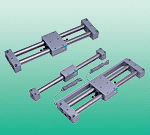
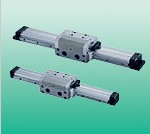
Detailed introduction of CKD cylinder CMK2-00-32-100:
CKD cylinder stock, genuine CKD cylinder, cylinder CMK2-00-32-100, price has an absolute advantage, welcome your call!
The middle cover and piston divide the cylinder into three chambers: air storage chamber, head chamber, and tail chamber. It is widely used in various operations such as feeding, punching, crushing, and forming.
A cylinder that reciprocates back and forth is called a swing cylinder, which is divided into two by vanes, and air is alternately supplied to the two chambers, causing the output shaft to swing back and forth,
with a swing angle less than 280°. In addition, there are rotary cylinders and pneumatic dampers. In CKD pneumatic transmission, the pressure energy of compressed gas is converted into mechanical energy,
pneumatic actuators. Cylinders can be divided into two types: those that reciprocate linearly and those that reciprocate back and forth (see diagram). Linear reciprocating cylinders can be further divided into
single-acting, double-acting, diaphragm, and impact cylinders.
①Single-acting cylinder: Only one end has a piston rod, and air is supplied to one side of the piston to generate pressure, which pushes the piston to extend. It returns by spring or gravity.
②Double-acting cylinder: Air is alternately supplied from both sides of the piston, outputting force in one or both directions.
③Diaphragm cylinder: A diaphragm is used instead of a piston, outputting force in only one direction, and is reset by a spring. It has good sealing performance, but the stroke is short.
④Impact cylinder: This is a new type of component. It converts the pressure energy of compressed gas into the kinetic energy of a piston moving at high speed (10~20 meters/second), and uses it to do work. The impact cylinder adds a cover with a nozzle and a drain port.
T2YLH?T2YLV Application: Dedicated to programmable logic controllers
Power supply voltage: -
Load voltage?Current: DC10~30V、5~20mA Note 1
Indicator light: Red/Green Light Emitting Diode (ON when the light is on)
Maximum impact: 980 m / S2T3YLH?T3YLV Application: Programmable logic controllers, relays
Power supply voltage: DC10~28V
Load voltage?Current: DC30V or less, 50mA or less
Indicator light: Red/Green Light Emitting Diode (ON when the light is on)
Maximum impact: 980 m / S2CKD cylinder CMK2-00-32-100
CMK2-00-20-30,CMK2-00-20-50,CMK2-CC-20-25 and other CKD first-tier agents, Ms. Xu 021-60510396
CMK2-CC-20-15, CMK2-00-32-250, CMK2-00-32-100 and other CKD first-tier agents, Ms. Xu 021-60510396
CMK
Ultra-compact cylinder CMK2-00-32-100 belongs to the Air Pressure Cylinders series under CKD company, model number CMK2-00-32-100. To purchase or inquire about Ultra-compact cylinder CMK2-00-32-100, you can directly contact 158 0047 0089 (Mr. He).
1. Cylinders: Used to convert the energy of compressed air into mechanical energy to produce linear motion.
2. Pneumatic valves: Used to control the direction, speed, and pressure of airflow, regulating the operation of pneumatic systems.
3. Pneumatic motors: Devices that convert compressed air into rotary motion.
4. Air tubes and connectors: Used to connect various components in pneumatic systems and transmit air.
Yes, CKD pneumatic components require regular maintenance to ensure normal operation and extend service life. Key maintenance points include:
- Regularly check and replace seals and gaskets to prevent air leakage.
- Inspect and clean filters to ensure clean air quality.
- Lubricate moving parts to reduce wear and improve efficiency.
- Check air tubes and connectors to ensure secure and undamaged connections.
When selecting the appropriate CKD pneumatic components, consider the following factors:
Application requirements: Understand the specific working environment and tasks, such as load, speed, and stroke.
Air source conditions: Ensure that the pressure and flow of the air source meet the component’s requirements.
Installation space: Confirm available space and choose components of suitable size.
Environmental factors: Consider the temperature, humidity, and potential corrosiveness of the working environment to select suitable materials and designs.
Common pneumatic system faults include:
Air leakage: Causes efficiency decline; check seals, connections, and tubes, find leak points, and repair or replace.
Stuck cylinder piston: Possibly caused by dirt or insufficient lubrication; clean the piston and add lubricant.
Valve failure: Check electrical control signals, ensure smooth airflow, and verify if the valve itself is damaged.
Insufficient pressure: Inspect air source pressure, filters, and piping to ensure no blockage or leakage.