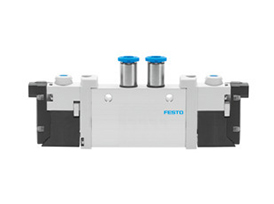
FESTO (Festo) Electric Control Valve VLK - 3 - PK - 3 Basic Overview
FESTO (Festo), as a renowned company in the field of automation technology, is known for the high quality and reliability of its products. The electric control valve VLK - 3 - PK - 3 is an important product under the Festo brand with significant application value. This electric control valve plays a key role in industrial automation systems, capable of precisely controlling the flow of fluids, providing stable support for various industrial production processes.
From the perspective of design, VLK - 3 - PK - 3 adopts a compact and robust structure. This design not only saves installation space but also adapts to harsh industrial environments. The housing material has excellent protective properties, effectively resisting the effects of dust, moisture, and other factors, thus ensuring the stability and reliability of the electric control valve during long-term use.
In terms of electrical connections, the electric control valve is equipped with standard electrical interfaces, facilitating connections with various control systems. Users can easily integrate it into existing automation systems according to actual needs, achieving precise control over fluids. At the same time, this standardized interface reduces the difficulty of maintenance and replacement, enhancing the maintainability of the system.
FESTO (Festo) Electric Control Valve VLK - 3 - PK - 3 Working Principle and Performance Features
The working principle of VLK - 3 - PK - 3 is based on electromagnetic control technology. When the electric control valve receives a control signal, the electromagnet generates a magnetic field, driving the valve core to move, thereby changing the opening and closing state of the valve, achieving on-off control of the fluid. This control method is characterized by a fast response speed and high control precision, capable of meeting the fluid control requirements of most industrial production processes.
In terms of performance features, the electric control valve has excellent flow characteristics. It can maintain stable flow output under different pressures and flow conditions. This is due to its optimized valve core design and precise manufacturing processes, allowing for smooth transitions during the opening and closing of the valve, reducing fluid shock and fluctuation.
Moreover, VLK - 3 - PK - 3 also has good sealing performance. The sealing materials use high-quality rubber or plastic, effectively preventing fluid leakage and ensuring the safety and reliability of the system. At the same time, the electric control valve has low power consumption, saving users a significant amount of energy costs during long-term operation.
In terms of the operating temperature range, VLK - 3 - PK - 3 has a wide adaptability. It can operate normally in a temperature environment of -20℃ to 80℃, making it suitable for various different industrial scenarios, whether in the cold northern regions or the hot southern regions, it can operate stably and reliably.
FESTO (Festo) Electric Control Valve VLK - 3 - PK - 3 Application Areas and Market Prospects
Electric control valve VLK-3-PK-3 belongs to the Valves and Islands series under FESTO company, model number VLK-3-PK-3. To purchase or inquire about Electric control valve VLK-3-PK-3, you can directly contact 158 0047 0089 (Mr. He).