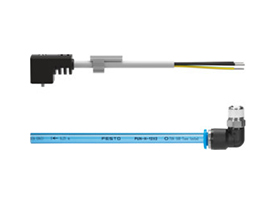
FESTO (Festo) Flange Mounting Part FNC - 63 Overview
FESTO (Festo), as a globally renowned supplier of automation technology, is known for its products' high quality, innovative design, and superior performance. The FNC - 63 flange mounting part is an important product in the Festo product line and is widely used in the field of industrial automation.
The FNC - 63 flange mounting part is mainly used for connecting and securing various equipment, providing a stable mounting base for the equipment and ensuring stability and reliability during operation. Its design fully considers the complexity and diversity of industrial environments, featuring good versatility and compatibility, and can be used in conjunction with various equipment from Festo and other brands.
This mounting part is made of high-quality materials, offering high strength and durability, capable of withstanding significant pressure and impact. Additionally, its surface has been specially treated to have excellent corrosion resistance, allowing for long-term use in harsh industrial environments without damage.
Features of FESTO (Festo) Flange Mounting Part FNC - 63
Firstly, in terms of design, the FNC - 63 flange mounting part has precise dimensions and tolerance control. This ensures perfect matching with equipment during installation, guaranteeing the accuracy and stability of the installation. Precise dimensions also reduce errors during installation, improving installation efficiency and reducing installation costs.
Secondly, the mounting part has good sealing properties. In industrial production, many devices need to operate in specific environments, requiring high sealing performance. The FNC - 63 flange mounting part features special sealing design, effectively preventing the leakage of liquids, gases, and other media, ensuring the normal operation of equipment. Good sealing also reduces energy waste and improves equipment operating efficiency.
Furthermore, the installation and removal of the FNC - 63 flange mounting part are very convenient. It employs advanced connection methods that do not require complex tools or techniques to complete installation and removal operations. This is particularly significant for industrial production that requires frequent equipment replacement or maintenance. Convenient installation and removal can reduce equipment downtime and improve production efficiency.
In addition, the mounting part also has good shock resistance. In industrial production, equipment is often affected by various vibrations, which can lead to damage and failure. The FNC - 63 flange mounting part, through special structural design and material selection, can effectively absorb and buffer vibrations, protecting equipment from the impact of vibrations and extending the service life of the equipment.
Application Scenarios of FESTO (Festo) Flange Mounting Part FNC - 63
In automated production lines, the FNC - 63 flange mounting part is widely used for connecting and securing various mechanical equipment. For example, in the installation of robotic arms, it provides stable support for the robotic arms, ensuring their smooth operation in
Flange fitting FNC-63 belongs to the Connection Technology series under FESTO company, model number FNC-63. To purchase or inquire about Flange fitting FNC-63, you can directly contact 158 0047 0089 (Mr. He).