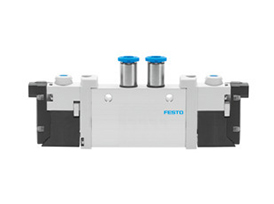
FESTO (Festo) Pneumatic Control Valve VL/O - 3 - 1/2 - EX Overview
FESTO (Festo), as a globally renowned supplier of automation technology, is known for the high quality, reliability, and innovation of its products. The pneumatic control valve VL/O - 3 - 1/2 - EX is one of the many excellent products from Festo. This pneumatic control valve is widely used in the field of industrial automation, mainly for controlling the flow direction, pressure, and flow rate of gases, to achieve precise control of pneumatic systems.
From the model number, 'VL/O' represents the series of the pneumatic control valve, '3' typically indicates the number of functional positions of the valve, '1/2' indicates the size of the valve's interface, and 'EX' may imply that the valve has some special performance features or is suitable for specific environments, such as possibly being an explosion-proof design suitable for hazardous environments with flammable and explosive gases.
The Festo pneumatic control valve VL/O - 3 - 1/2 - EX employs advanced design concepts and manufacturing processes. Its internal structure is compact, and the external design is reasonable, making it convenient for installation on various types of equipment while effectively saving space. At the same time, the valve is made of high-quality materials, possessing good corrosion resistance and wear resistance, allowing it to operate stably for long periods in harsh industrial environments.
Performance Characteristics of the FESTO (Festo) Pneumatic Control Valve VL/O - 3 - 1/2 - EX
In terms of flow characteristics, the Festo pneumatic control valve VL/O - 3 - 1/2 - EX performs exceptionally well. It can provide a large flow rate, meeting the needs of rapid gas transport and control in industrial production. Through optimized internal flow channel design, the resistance to gas flow is reduced, allowing gas to pass through the valve more smoothly, thereby improving the overall efficiency of the pneumatic system.
The response speed of this pneumatic control valve is also very fast. After receiving the control signal, it can act quickly to achieve rapid switching and control of gases. This is crucial for industrial production processes with high time requirements, such as rapid sorting and positioning in automated production lines, ensuring the system's real-time performance and accuracy.
In terms of sealing, the Festo pneumatic control valve VL/O - 3 - 1/2 - EX uses high-quality sealing materials and advanced sealing structures. It effectively prevents gas leakage, ensuring the stability and safety of the pneumatic system. Even during long-term use, the sealing performance does not significantly deteriorate, reducing maintenance costs and downtime.
Additionally, the valve has good anti-interference capabilities. It can operate normally in complex electromagnetic environments and industrial noise,不受外界干扰信号的影响,确保了控制信号的准确传输和执行,提高了系统的可靠性。
Application Scenarios of the FESTO (Festo) Pneumatic Control Valve VL/O - 3 - 1/2 - EX
In the汽
Pneumatic Valve VL/O-3-1/2-EX belongs to the Valves and Islands series under FESTO company, model number VL/O-3-1/2-EX. To purchase or inquire about Pneumatic Valve VL/O-3-1/2-EX, you can directly contact 158 0047 0089 (Mr. He).