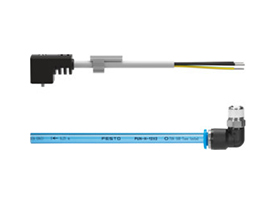
FESTO (Festo) Plastic Air Hose PUN - H - 6X1 - BL Overview
FESTO (Festo), as a globally renowned supplier of automation technology, is known for its products' high quality, high performance, and innovative design. The Festo plastic air hose PUN - H - 6X1 - BL is one of its many high-quality products. This hose is widely used in the field of industrial automation, providing reliable support for the stable operation of various pneumatic systems.
“PUN - H” represents the specific series of this hose, which has a series of unique performance characteristics. “6X1” specifies the size of the hose, where “6” indicates an outer diameter of 6mm and “1” indicates a wall thickness of 1mm. “BL” typically stands for blue, meaning the color of this hose is blue, which in practical applications can方便用户进行区分和管理方便用户进行区分和管理方便用户进行区分和管理方便用户进行区分和管理方便用户进行区分和管理方便用户进行区分和管理方便用户进行区分和管理方便用户进行区分和管理方便用户进行区分和管理方便用户进行区分和管理方便用户进行区分和管理方便用户进行区分和管理方便用户进行区分和管理方便用户进行区分和管理方便用户进行区分和管理方便用户进行区分和管理方便用户进行区分和管理方便用户进行区分 and management.
FESTO (Festo) Plastic Air Hose PUN - H - 6X1 - BL Performance Features
Firstly, in terms of material, this hose uses high-quality plastic material. This plastic has good flexibility, allowing the hose to easily bend during installation and adapt to various complex installation environments, reducing installation difficulty and time costs. It also has excellent wear resistance, ensuring the service life of the hose by resisting friction and wear during long-term use.
Secondly, the hose has good resistance to chemical corrosion. In industrial environments, the hose may come into contact with various chemicals, such as acid and alkali solutions, oil污等。Festo plastic air hose PUN - H - 6X1 - BL can effectively resist the erosion of these chemicals, ensuring that the gas transmission inside the hose is not affected, improving the stability and reliability of the system.
Furthermore, it has excellent air tightness. In pneumatic systems, good air tightness is crucial as it prevents gas leakage and ensures the stability of system pressure. The Festo hose undergoes strict production processes and quality inspections to ensure that there will be no gas leakage even in high-pressure environments, providing strong support for the normal operation of pneumatic equipment.
Additionally, the hose has a low friction coefficient. This means that the resistance to gas flow within the hose is small, allowing for smoother transmission and improving the efficiency of the pneumatic system while reducing energy consumption.
FESTO (Festo) Plastic Air Hose PUN - H - 6X1 - BL Application Scenarios
In automated production lines, the Festo plastic air hose PUN - H - 6X1 - BL has a wide range of applications. For example, in the pneumatic control systems of robotic arms, hoses need to bend and move frequently to achieve various movements of the robotic arms. The flexibility and wear resistance of this hose allow it to adapt well to this work environment, ensuring the stable operation of the robotic arms.
In the packaging industry, pneumatic equipment is commonly used for
Plastic Air Hose PUN-H-6X1-BL belongs to the Connection Technology series under FESTO company, model number PUN-H-6X1-BL. To purchase or inquire about Plastic Air Hose PUN-H-6X1-BL, you can directly contact 158 0047 0089 (Mr. He).